
Quick Answer: How To Spot Overhyped Tech Products
Learning how to spot overhyped tech products is not about becoming cynical about new technology. It is about knowing when the excitement is backed by something real.
The easiest way to spot an overhyped tech product is to ask one question:
What real problem does this solve better than the thing I already use?
If the answer is clear, specific, and useful, you may have something worth paying attention to. If the answer is mostly “AI-powered”, “revolutionary”, “smart”, “future-ready”, or “changes everything” without much detail, pause before getting your wallet involved.
That does not mean new tech is bad. Quite the opposite. New technology is fun. The best launches make you want to lean forward a bit because they show a smarter way to work, play, create, learn, move, communicate, or live.
The real skill is learning how to spot overhyped tech products without losing the fun of discovering what is new.
But excitement and evidence are not enemies. The good stuff can handle a few questions.
Why Tech Hype Happens
Technology companies need attention. Product launches are designed to create a moment.
That is why a normal upgrade becomes a breakthrough. A helpful feature becomes a revolution. A device with one AI feature becomes an AI device. A gadget that might be useful one day gets shown under perfect lighting with a soundtrack that suggests your toaster has discovered consciousness.
Sometimes the excitement is deserved. AI tools, smart glasses, robotics, health tech, new laptop chips, home automation, accessibility devices, and wearable tech are all moving quickly. There is genuinely interesting work happening.
The problem is that useful innovation and empty hype often arrive wearing the same jacket.
CES 2026 was a good example of the current mood. Official CES coverage leaned heavily into physical AI, robotics, smart home technology, accessibility, wearables, and connected living. Deloitte’s 2026 technology signals also highlighted physical AI, robotics, agentic AI, AI-native wearables, and cybersecurity in the AI age. In other words: the future-looking stuff is not imaginary. It is very much happening.
But a launch demo is not the same as a product you should buy.
SignalTrove’s approach is simple: be excited by what is next, then check whether it actually works for real people.
Hype Signal Vs Useful Signal
| Hype signal | What to check instead |
|---|---|
| “AI-powered” with no detail | What does the AI actually do for the user? |
| “Revolutionary” or “game-changing” | What problem does it solve better than existing products? |
| A perfect demo only | Does it work in normal homes, offices, lighting, Wi-Fi, and weather? |
| No clear price | What does it cost after accessories, subscriptions, or upgrades? |
| No release date | Is it shipping, delayed, a preorder, or only a concept? |
| No support details | How long will updates, parts, security fixes, or app support last? |
| Requires a new ecosystem | What happens if you stop using that brand’s app or service? |
| Uses cameras, microphones, sensors, or health data | What data is collected, stored, shared, or processed? |
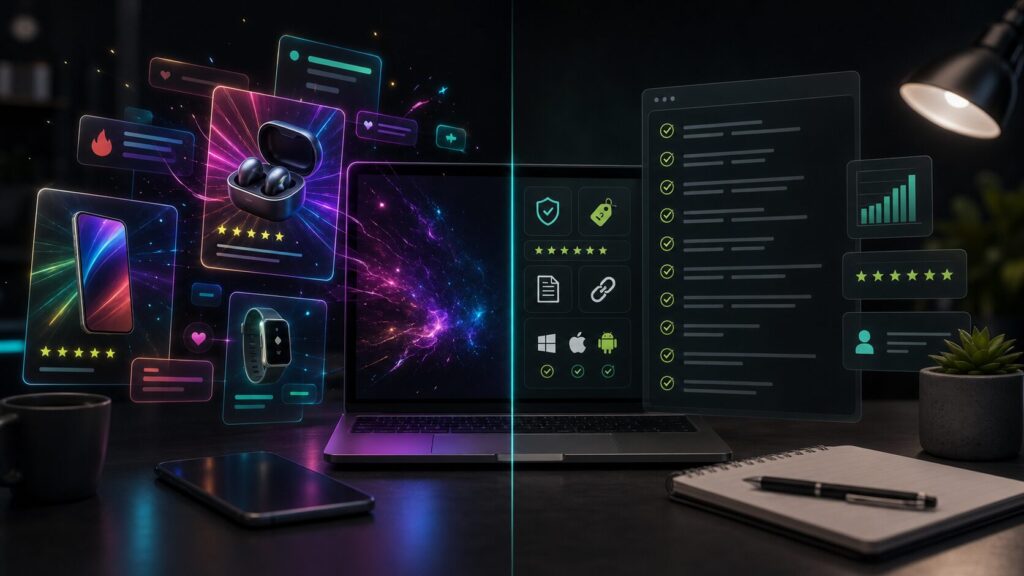
This works for almost any product category: AI tools, laptops, wearables, smart home devices, phones, earbuds, kitchen tech, robot gadgets, apps, subscriptions, and accessories.
1. Start With The Real Problem
Do not start with the feature. Start with the annoyance.
Ask:
- What problem does this remove?
- What task does it make easier?
- What does it replace?
- Who is it clearly for?
- Would I still want it if the trendiest word was removed from the box?
A great gadget usually has a boringly clear benefit. A smaller charger that powers your laptop and phone from one plug? Useful. A smart speaker that makes your lights, music, reminders, and routines easier to manage? Useful, if it fits your home. Noise-cancelling earbuds that make the train slightly less chaotic? Hero behaviour, honestly.
But if the main benefit is “it has AI” or “it is smart”, keep digging.
For practical low-cost upgrades, see our guide to the best budget tech gadgets for everyday use.
2. Be Curious About AI, But Do Not Let The Label Do All The Work
AI can be brilliant. It can also be a sticker.
A product saying it has AI does not tell you enough. You need to know what the AI feature actually does.
Good AI claims are specific:
- Summarises your notes
- Removes background noise from calls
- Detects people, pets, or packages
- Suggests edits to a photo
- Helps search your files
- Runs locally on the device for privacy
- Automates a real task you already do
Weak AI claims are vague:
- Makes life smarter
- Learns your lifestyle
- Personalises everything
- Uses advanced intelligence
- Brings the future to your home
The question is not “Does this have AI?” The better question is:
Would this product still be useful if the AI feature was switched off?
If yes, the AI might be a bonus. If no, the AI needs to be genuinely good, reliable, private enough for the job, and worth the extra cost.
For AI tools specifically, our guide on how to choose your first AI tool without wasting money is a good next read.
3. Check Whether It Exists Beyond The Demo
Some products look amazing in controlled demos.
Real life is less polite. Homes have awkward Wi-Fi, weird lighting, pets, background noise, older phones, messy desks, thick walls, impatient humans, and someone who absolutely will not read the setup instructions.
Before trusting a launch demo, check:
- Is it shipping now?
- Is it only a prototype?
- Is there a confirmed UK release?
- Are independent reviewers using it?
- Are normal customers reporting issues?
- Does the demo show real use or only a perfect scenario?
- Are important features available now, or “coming soon”?
This matters for robotics, smart home products, AI wearables, health tech, and anything that claims to understand your environment.
If the product only exists in a launch video, treat it as interesting, not proven.
4. Watch For Hidden Costs
The price on the product page is not always the real price.
Modern tech can come with subscriptions, cloud storage, replacement parts, premium features, proprietary accessories, extra hubs, required apps, paid AI credits, or ecosystem lock-in.
Before buying, check:
- Does it need a subscription?
- Are useful features locked behind a paid plan?
- Does it need a hub, app, account, or cloud service?
- Does it work with your existing phone, laptop, router, or smart home setup?
- Are batteries replaceable?
- Are accessories included?
- Are returns easy if it does not work for you?
- Will it still be useful if you stop paying?
A cheap gadget with a required subscription may not be cheap. A pricier product with long support and no hidden costs may be better value.
This is why good buying advice looks at total cost, not just launch price.
5. Check Support, Updates, And Longevity
Good tech needs support.
That is obvious for phones and laptops, but it also matters for smart plugs, cameras, wearables, routers, robot devices, AI tools, and anything controlled by an app. If a product depends on software or cloud services, it can become worse over time if the company loses interest.
Look for:
- Update policy
- Warranty
- Spare parts
- App reviews
- Customer support reputation
- Compatibility with common standards
- Security update information
- Whether the product works without cloud access
This is especially important for smart home gear. A normal lamp can work for years. A smart lamp with a dead app can become an expensive mood light with trust issues.
The more a product depends on software, the more support matters.
6. Treat Privacy As A Product Feature
Privacy is not just a legal page at the bottom of a website. It is part of the product.
Be more cautious when a device includes:
- Cameras
- Microphones
- Location tracking
- Health data
- Children’s data
- Home access
- Personal documents
- Financial or identity information
Ask:
- What data does it collect?
- Is data processed on-device or in the cloud?
- Can you delete recordings or history?
- Can you turn features off?
- Does the product work if you limit data sharing?
- Has the company explained privacy clearly?
This matters even more as AI appears in more everyday products. The FTC has repeatedly warned about deceptive AI claims and consumer harm, especially where companies overpromise what AI can do or use it in ways that affect privacy, security, money, work, health, or personal data.
If a product wants access to your home, body, voice, documents, or routine, the company should be able to explain why in plain English.
7. Look For Independent Evidence
A launch page tells you what the company wants you to believe.
Independent evidence tells you whether the product is holding up.
Look for:
- Hands-on reviews
- Long-term reviews
- User complaints
- App store reviews
- Return-policy comments
- Forum discussions
- Support pages
- Update history
Be careful with early reviews that only repeat the press release. The best reviews usually mention tradeoffs.
No product is perfect. A review with no drawbacks can be less useful than one that explains who should avoid the product.
8. Check Whether It Fits Your Setup
Even good products can be bad purchases if they do not fit your existing setup.
Before buying, check:
- iPhone or Android compatibility
- Windows, macOS, ChromeOS, or Linux support
- Smart home compatibility
- Wi-Fi requirements
- Plug type
- App availability in the UK
- Subscription availability in your region
- Whether features vary by country
This is a common trap with imported gadgets, crowdfunding products, and new AI features. The product may exist, but not all features may work where you live.
For a UK-first technology site, availability matters. A feature that only works in the US is not much help when you are sitting in Birmingham with a cup of tea and a gadget that has decided geography is your problem.
9. Avoid Buying On Launch Emotion
The riskiest time to buy some tech products is when the launch hype is loudest.
That is when:
- Reviews may be limited
- Bugs are still unknown
- Prices are highest
- Stock pressure creates urgency
- Marketing is strongest
- Real-world drawbacks are not clear yet
Sometimes early adoption is fine. If you love experimenting and understand the risk, go for it. Being first can be part of the fun.
But if you want value, waiting can be sensible.
Waiting a few weeks can reveal:
- Real battery life
- Software bugs
- App problems
- Durability issues
- Better alternatives
- Price drops
- Whether promised features actually arrive
Useful technology does not stop being useful after launch week.
10. Use The SignalTrove Hype Check
Before buying a hyped tech product, ask:
- Does it solve a real problem?
- Is the benefit clear without buzzwords?
- Has anyone independent tested it?
- Does it work in the UK?
- Does it need a subscription?
- What data does it collect?
- How long will it be supported?
- Does it work with what I already own?
- Is there a cheaper product that solves the same problem?
- Would I still want it after the launch excitement fades?
If you cannot answer most of these, wait.
Waiting is not being boring. It is how you avoid becoming a product’s unpaid beta tester.
Useful Sources For Checking Tech Claims
These are good places to check before trusting a big product claim:
- CES official news
- FTC consumer advice
- Deloitte Technology Trends
- IEEE Computer Society technology predictions
- Official product pages, support pages, warranty pages, and privacy policies
Do not rely on one source. A product page, a hands-on review, and real customer feedback together are much stronger than a single launch post.
FAQ
What Is An Overhyped Tech Product?
An overhyped tech product gets more attention than its real-world usefulness deserves.
It may have impressive marketing, a strong launch demo, trendy features, or lots of buzz, but weak evidence that it solves a real problem for normal users.
Does AI Make A Product Overhyped?
No. AI can make a product genuinely better.
The problem is vague AI branding. If a company says a product uses AI, check what the AI actually does, whether it works reliably, and whether it improves the product enough to matter.
Should I Avoid New Tech Products?
Not always. New tech can be exciting, useful, and genuinely worth trying.
The point is to avoid buying purely on launch excitement. Check reviews, compatibility, support, privacy, and total cost before spending money.
How Long Should I Wait Before Buying A New Product?
For expensive products, waiting a few weeks or months can help. Early buyers often discover bugs, missing features, battery issues, or support problems.
For cheap accessories, the risk is lower, but it is still worth checking reviews and return policies.
What Is The Biggest Red Flag?
The biggest red flag is a product that cannot clearly explain what problem it solves.
If the pitch is mostly buzzwords, lifestyle images, vague AI language, and urgency, be careful.
Final Recommendation
New tech should be exciting. That is the whole point.
The best products make the future feel a little closer because they solve a real problem, make something easier, or open up a genuinely better way to do things.
But the strongest excitement comes after the basic checks. Does it work? Is it useful? Is it supported? Is it private enough for the job? Does it fit your setup? Is the price honest?
If the answer is yes, brilliant. Get excited.
If the answer is unclear, give it time.
SignalTrove is plugged into what is next, but the good stuff still has to earn the signal.